


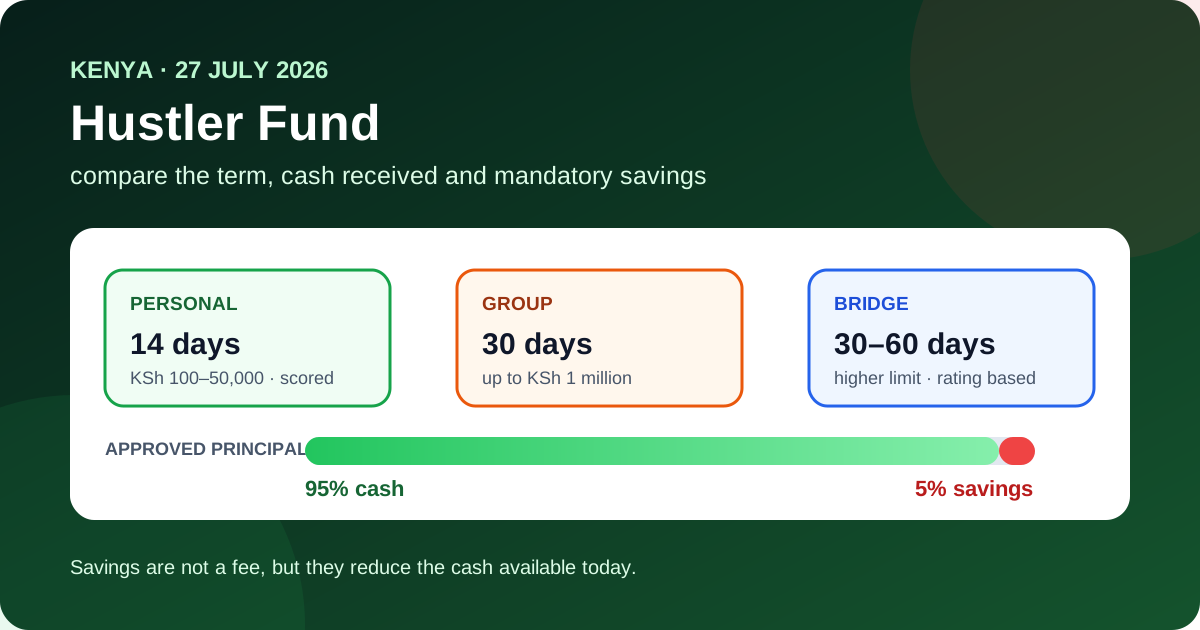
BP25-32-U3-KEKenya’s Hustler Fund is still operating in 2026, but the useful question is not simply whether it is “cheap.” A Personal Loan may approve KSh 1,000 while sending only KSh 950 to the mobile wallet: the other KSh 50 becomes mandatory savings. Interest is then calculated on the full KSh 1,000. That split makes the product different from both a processing-fee loan and a normal cash advance.
What the Hustler Fund is in 2026
Hustler Fund is the public name of Kenya’s Financial Inclusion Fund. It was established by the Public Finance Management (Financial Inclusion Fund) Regulations, 2022. The regulations place policy responsibility with the ministry responsible for micro, small and medium enterprises and create an Advisory Board, a chief executive and a Fund administrator.
The current official website, an April 2026 parliamentary oversight update and active product pages all indicate that the programme continues to operate. The absence of a fresh Exchequer allocation in the FY 2026/27 budget changes how new lending is funded; it does not, by itself, prove that the Fund has closed. Government statements describe a move toward recycling repayments through a revolving fund. That claim should be read as the operating plan, not as proof that every old loan will be recovered.
The Fund uses existing mobile-payment infrastructure, so it sits inside the same everyday financial system covered in our guide to mobile money in Kenya. It is nevertheless a government fund governed by its own regulations and scoring model, not a commercial loan app or a bank deposit account.
Personal, Group and Bridge loans are different products
| Feature | Personal Loan | Group Loan | Bridge Loan |
|---|---|---|---|
| Who it is for | Individuals and informal micro-entrepreneurs | Registered groups with at least 10 members | Top-rated repeat borrowers in Category A and some in Category B |
| Published limit | KSh 100 to KSh 50,000, subject to scoring | Up to KSh 1,000,000 for the group | Higher, score-based limits; the current official product page gives no fixed maximum |
| Term | 14 days | 30 days | 30 to 60 days |
| Rate wording | 8% per year, calculated daily; 9.5% per year after default | The product page omits a separate number; the Fund regulations set a maximum base rate of 8% per year and 9.5% after default | The official page describes 8% within 30 days and 9.5% from day 31 to day 60 |
| Cash and savings | 95% to the wallet; 5% to personal savings | 95% to the group wallet; 5% to group savings | 95% to the wallet; 5% to personal savings |
| Main risk | A short repayment window and a cash amount smaller than the approved principal | Repayment depends on group governance and member agreement | Access depends on past behaviour; late payment can reduce the internal rating and future limits |
The Personal Loan limit comes from the current official page. The Group Loan page publishes its KSh 1 million ceiling and 30-day term. The Bridge page promises larger limits but does not state a hard maximum, so figures quoted by older articles or third-party sites should not be treated as a current official ceiling.
A KSh 1,000 Personal Loan: cash received versus amount owed
Assume a KSh 1,000 Personal Loan remains outstanding for the full 14-day term. The official rate is 8% per year, calculated daily, and 5% of the approved principal is reserved as savings.
The interest calculation is KSh 1,000 × 8% × 14 ÷ 365, which is approximately KSh 3.07. The repayment after 14 days is therefore about KSh 1,003.07. The borrower has only KSh 950 of new spending cash, while KSh 50 remains in restricted savings.
The savings are not a lender fee: they still belong to the borrower. They do, however, reduce immediate liquidity. A fair comparison must therefore show all three numbers — approved principal, usable cash and repayment — rather than advertising only the 8% annual rate.
Status check: 27 July 2026
The Financial Inclusion Fund still publishes active Personal, Group and Bridge products. Kenya’s FY 2026/27 budget did not add fresh Exchequer capital to the Fund, while government statements describe new lending as increasingly dependent on recovered money. That is a funding change, not evidence that the programme has shut down.
In June 2026, the National Treasury said the Fund had disbursed about KSh 87 billion across 28 million registered accounts since launch. The account figure should not be rewritten as 28 million unique borrowers: multiple mobile lines and repeat borrowing make those measures different.
A 23 July 2026 report quoting the Fund’s chief executive put outstanding unpaid loans at about KSh 12.5 billion and described a new option to offset balances with Safaricom Bonga Points. Both figures are dated operational snapshots. They do not alter the published product rate, savings split or repayment term, and they will need refreshing when newer official accounts are released.
How the mandatory savings split works
For a Personal or Bridge Loan, the current official savings page says 70% of the mandatory 5% goes to long-term savings and 30% goes to short-term savings. In the KSh 1,000 example, that means KSh 35 long term and KSh 15 short term. For a Group Loan, the full 5% goes to the group’s savings account.
The same page says short-term savings can be withdrawn when there is no active loan. Long-term savings are intended for retirement at age 60, while the page also describes limited access to 30% every five years before retirement. Older official FAQs use different wording for short-term access, so a borrower should not budget on an early withdrawal date unless the current terms for that account confirm it.
Group savings have a separate restriction: the official page says the group can withdraw only when no member has an unpaid loan. One member’s arrears can therefore affect the whole group’s access to the savings balance.
Eligibility does not guarantee a limit
The regulations require an individual applicant to be at least 18 and hold a Kenyan national identity card. The current Personal Loan page also lists an eligible mobile-money account and a SIM that has been active for at least 90 days. Meeting those conditions only makes a person eligible for assessment; it does not promise approval or the KSh 50,000 maximum.
The Fund uses its own behavioural score, called the Hustler Rating. Categories A, B and C reflect borrowing, repayment and savings behaviour. Timely repayment may improve the category and future limit, while late payment can reduce both. The Bridge Loan is reserved for stronger existing records rather than being a separate first-time application route.
This internal rating is not the same thing as a commercial Credit Reference Bureau report. Current Fund regulations and product pages do not confirm a policy of formally listing every Hustler Fund defaulter with a CRB. Articles that call default an automatic “CRB blacklist” go beyond the primary documents.
What default actually changes
The regulations raise the applicable annual rate from a maximum of 8% to 9.5% when a beneficiary defaults, and state that sums due are recoverable as a debt due to the Fund. The product pages also link repayment behaviour to the internal rating, eligibility for higher limits and access to the Bridge product.
That is enough reason to take arrears seriously without inventing extra penalties. The official material reviewed for this page does not support claims of arrest, automatic seizure of unrelated property or universal CRB listing. It does support a higher default rate, continuing debt recovery and reduced access to future Fund credit.
If the need is a different form of short-term credit, compare the mechanics rather than the brand. M-Shwari is a bank-linked mobile loan, while Fuliza is an overdraft that completes qualifying M-Pesa transactions. Neither has the same 95% cash and 5% mandatory-savings structure as Hustler Fund.
Scale does not remove the governance risks
Official statements use very large cumulative disbursement and account totals. Those figures count activity across registered mobile accounts and should not automatically be presented as the same number of unique people. A person can use more than one mobile line, and repeated loans add to cumulative disbursement.
Reporting based on the Auditor-General’s FY 2023/24 work raised serious identity and data-quality questions. It cited KSh 31.8 million disbursed through 44,167 records associated with minors or future-dated birth records, as well as 104,631 loans worth KSh 116.5 million where national ID details were missing from the customer database. These are historical audit findings about controls, not current loan limits, but they show why headline reach should be read alongside verification and recovery performance.
Default statistics also vary by date and definition. Early-loan default ratios, current unpaid balances and the share of a portfolio classified as non-performing are not interchangeable measures. A dated snapshot is more honest than presenting one percentage as the Fund’s permanent repayment rate.
Official programme or imitation message?
Hustler Fund is a government programme, but its name can still be copied in fraudulent messages or fake pages. Do not pay an individual a release fee, share a PIN or approve an unexplained transaction because a message uses the Fund’s name. Check the domain, the sender and the exact terms independently.
For the broader distinction between a government programme, a bank-linked product and a regulated private lender, see mobile loans in Kenya. The checklist for verifying a private provider is in legit loan apps in Kenya. Those pages are comparison tools, not lists of guaranteed approvals.
Four numbers to write down before borrowing
- The approved principal used to calculate interest.
- The 95% cash amount that will actually reach the wallet or group account.
- The 5% savings amount and the restrictions on withdrawing it.
- The full repayment due within the product’s short term.
For a Personal Loan, the difference between approved principal and usable cash is easy to miss. If the repayment cannot be covered from income arriving before day 14, the low annual percentage does not make the cash-flow gap safe.
The decision is mainly about cash flow
The published annual rate is low compared with many short-term digital products, but the Personal Loan still matures in 14 days. Before accepting any amount, compare the repayment with income that will actually arrive before the due date. Do not count the restricted 5% savings as cash available for the repayment.
A Personal Loan is easiest to understand when the approved principal, wallet cash, savings balance and due amount are written on four separate lines. A Group Loan adds collective responsibility, while a Bridge Loan adds dependence on an internal rating. If those obligations are unclear, a higher limit is not an improvement.